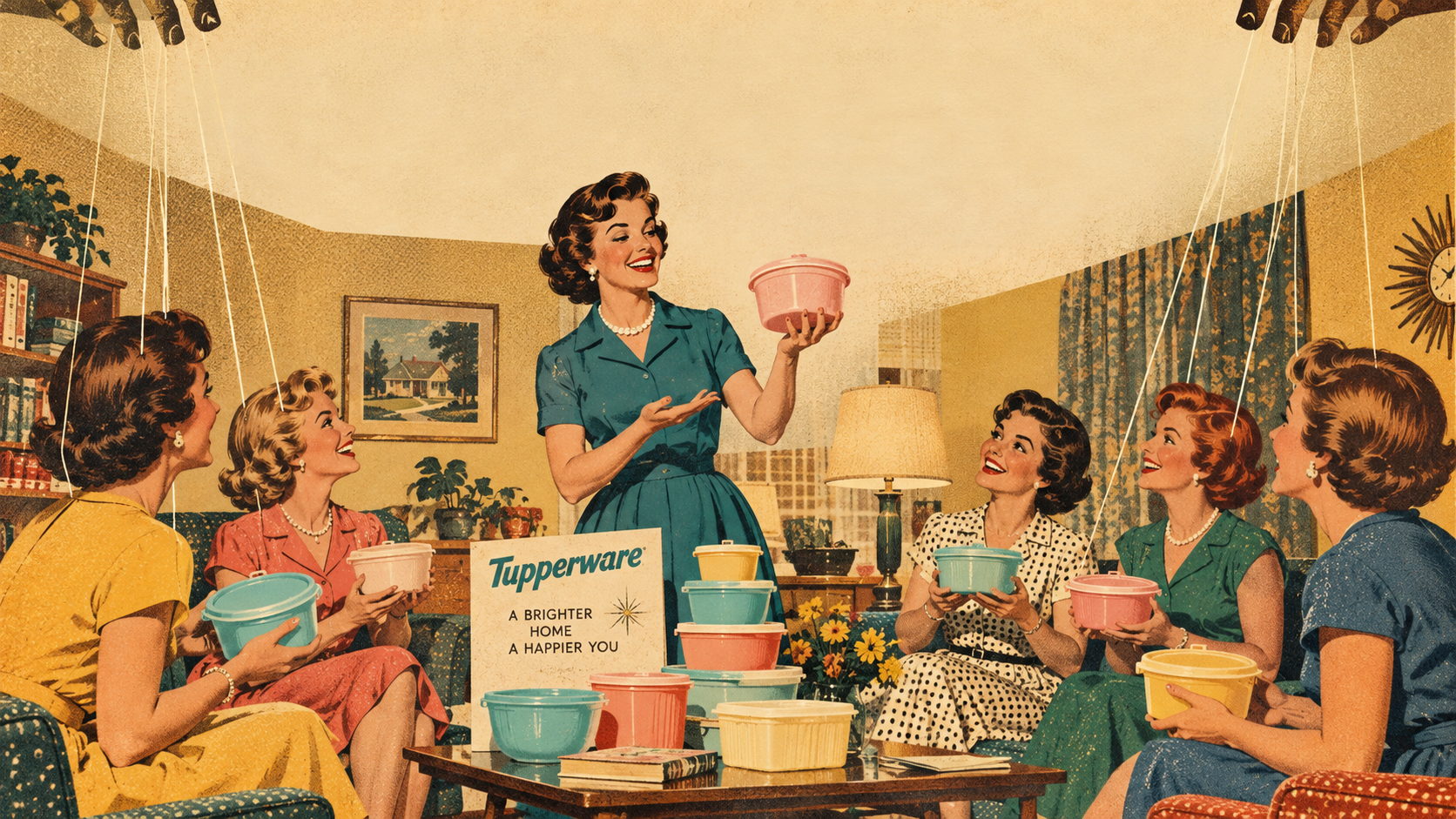
Selling Through Friendship: The Psychological Genius of the Tupperware Party
You came for coffee and conversation. You leave sixty dollars lighter, carrying a stack of pastel plastic bowls you never planned to buy — and, strangely, you feel good about it. No one pressured you. There was no pushy salesman, no aggressive pitch. Just an afternoon with friends. And yet the outcome was as reliable as clockwork, repeated in living rooms across the world, millions of times over.
That reliability is the tell. When something works this consistently, it isn't luck or charm — it's design. The Tupperware party was never really a social gathering that happened to sell containers. It was a finely tuned persuasion machine wearing the costume of a social gathering. And once you read Robert Cialdini's Influence: The Psychology of Persuasion, you can't unsee the gears turning underneath.
From store shelves to living rooms
Here's the part most people don't know: Tupperware almost failed. When Earl Tupper's airtight containers first hit hardware and department store shelves in the late 1940s, they barely moved. Shoppers didn't understand them. The famous "burp" seal needed a demonstration to make sense, and a product sitting silently on a shelf can't demonstrate anything.
The rescue came from a saleswoman named Brownie Wise, who noticed the containers sold briskly when someone showed them off in person — specifically, when a woman showed them off to her friends. Wise built an entire distribution model around that insight. By the mid-1950s, Tupperware pulled its products out of stores almost entirely and bet the company on the home party.
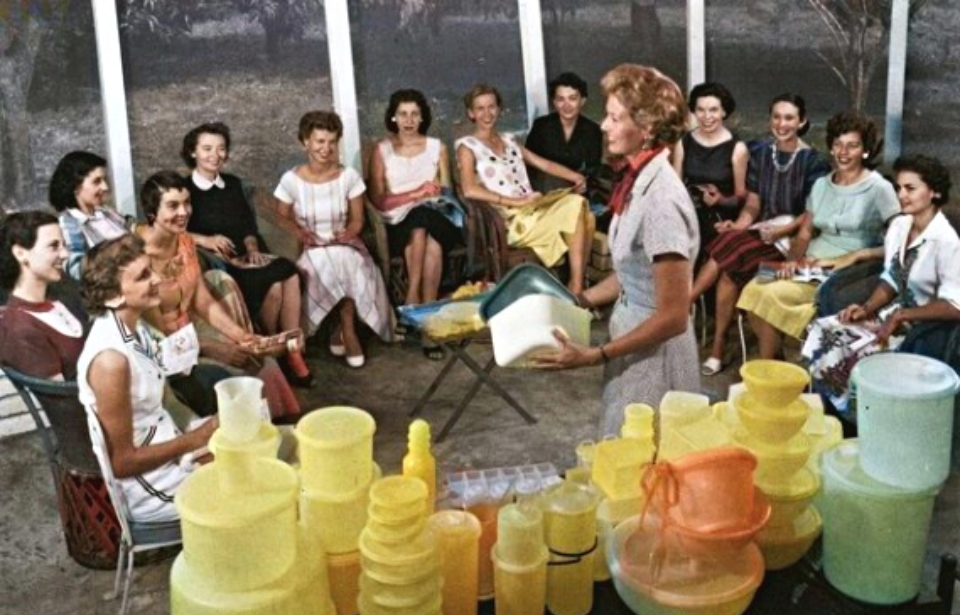
That decision looks obvious in hindsight, but notice what it really was: a bet that the setting mattered more than the product. The same bowl that couldn't sell on a shelf became irresistible in a friend's living room. Nothing about the plastic changed. Everything about the psychology did.
The machine, principle by principle
Cialdini's genius in Influence was to catalog the specific psychological levers — he calls them "weapons of influence" — that reliably nudge people toward yes. What makes the Tupperware party such a perfect case study is that it doesn't pull one lever. It pulls four at once, in sequence, each softening you up for the next.
Reciprocity: the gift that comes first
The party doesn't open with a sales pitch. It opens with games — and everyone wins a little prize before a single order is placed. A free gadget here, a small container there.
This is reciprocity, and it's older than commerce itself: when someone gives us something, we feel an almost physical need to give back. By the time the products come out, guests are already carrying a quiet debt. They didn't ask for the gifts, but that doesn't matter — the obligation lands anyway. Buying something becomes the natural way to settle the ledger.
Commitment and consistency: talk yourself into it
Next, the demonstrator invites guests to describe the Tupperware they already own and how they use it. Which pieces do you love? What do you store in them? How have they saved you time?
This feels like harmless small talk. It's actually the most underrated move in the room. Once you've said aloud, in front of others, that Tupperware has made your life better, buying more isn't a decision — it's just being consistent with the person you've already declared yourself to be. We are wired to align our actions with our stated beliefs, and the party gets you to state the belief before it asks for the action.
Social proof: everyone else is doing it
Then the orders begin, out in the open. You watch the woman beside you order a set. Then another. Then another.
Each purchase is a data point that answers the question we all quietly ask in moments of uncertainty: what are people like me doing? This is social proof, and it's most powerful precisely when we're unsure. Watching your peers — women in the same neighborhood, the same life stage, the same living room — reach for their wallets is far more convincing than any claim on a label. Their behavior becomes your evidence.
Liking: the request comes from a friend
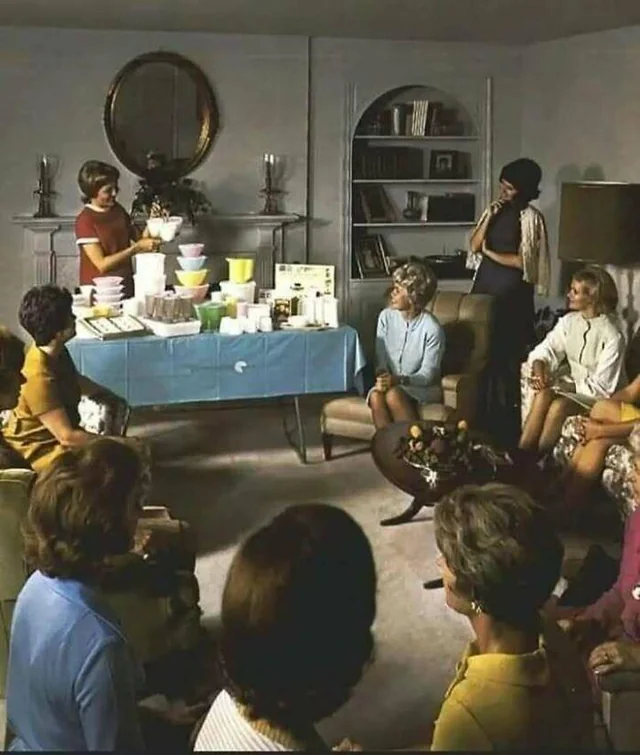
And here is the masterstroke. In a store, the pitch comes from a stranger whose job is to sell you something — and we've all built defenses against that. At the party, the real request doesn't come from the demonstrator at all. It comes, implicitly, from the hostess: your friend, who opened her home, served the snacks, and earns a cut of every sale.
Cialdini singles this out as the reason the whole model works. We say yes to people we know and like, and it is genuinely hard to say no to a friend in her own living room. The social bond does the selling. You're not buying plastic; you're supporting someone you care about. The commercial transaction has been perfectly disguised as an act of friendship.
The statistic that gives the game away
If all of this sounds like clever storytelling, there's a number that makes it concrete. Cialdini points to research by Frenzen and Davis, published in the Journal of Consumer Research in 1990, which studied exactly what drove purchases at these home parties.
The strength of the social bond between the hostess and the guest was twice as important in predicting a purchase as the guest's actual preference for the products themselves.
Read that again. Whether you liked the bowls mattered half as much as whether you liked your friend. That single finding is the entire scheme in miniature: the product was almost beside the point. The relationship was the product.
Why it still works today
It would be comfortable to file the Tupperware party under mid-century nostalgia — a quaint artifact of a world of housewives and station wagons. That would be a mistake, because the machine never went away. It just changed venues.
- Multi-level marketing companies — LuLaRoe, Herbalife, and countless others — run the exact same playbook, recruiting your friends to sell to their friends.
- Influencer "hauls" and unboxings are social proof and liking, scaled to millions: a person you feel you know showing you what people like you are buying.
- Referral codes and affiliate links monetize the hostess dynamic — "use my friend's code" is the living-room cut, digitized.
- Live shopping streams on Instagram, TikTok, and WhatsApp group sells recreate the whole party in real time: the countdown, the visible orders, the friendly host, the gentle debt.
The channels are new. The gears are identical.
The takeaway
There's nothing sinister about wanting a bowl, or supporting a friend, or trusting your neighbors' choices. These instincts exist because, most of the time, they serve us well. The point isn't to become paranoid — it's to become literate.
The defense against a persuasion machine is simply naming its parts. The next time a purchase starts to feel like friendship, or a debt, or just the natural thing that everyone's doing, pause and ask which lever is being pulled. Was I given something first? Did I talk myself into this out loud? Am I following the crowd? Is the real ask coming from someone I like?
Brownie Wise understood something most marketers still only fumble toward: people don't buy products, they buy their way deeper into their relationships. The Tupperware party just happened to be the most elegant machine ever built for turning that truth into sales — one living room at a time.